


Woven Wire Mesh Railing: Engineering and Specification Guide for Industrial and Architectural Infill
In industrial and commercial architecture, the selection of infill materials for railing systems requires a balance between structural integrity, safety compliance, and environmental durability. While woven wire mesh is traditionally associated with high-precision filtration, the same manufacturing principles apply to the production of heavy-duty panels used in a woven wire mesh railing. These systems provide a robust barrier that maintains visibility and airflow while meeting the stringent load requirements of modern building codes.
For engineers and procurement professionals, specifying the correct mesh involves understanding the interplay between wire diameter, aperture size, and material grade. This guide examines the technical considerations necessary to select and implement Plain, twill and dutch woven wire mesh in SS304/316L — rolls, cut mesh and framed panels. Send mesh count or micron target for a technical quote. within railing applications.
Engineering Fundamentals of Woven Wire Mesh in Railing Systems
The performance of a woven wire mesh railing is dictated by the mechanical properties of the mesh infill. Unlike expanded metal or perforated sheets, woven mesh is created by interlacing longitudinal (warp) and transverse (shute) wires. In railing applications, the stability of the weave is paramount to prevent wire displacement under impact or pressure.
Crimp Styles and Structural Rigidity
For architectural and safety infills, "pre-crimped" wire is typically used. Before weaving, the wires are passed through a series of dies to create indentations. This process ensures that the wires lock into place at their intersections, providing a rigid panel that does not sag or deform. Common crimp styles include:
* Lock Crimp: Features distinct knuckles at the intersections, providing maximum stability for large-aperture meshes.
* Intercrimp: Multiple crimps between intersections, ideal for lighter-gauge wires to maintain consistent spacing and stiffness.
* Flat Top: All crimping is offset to one side, creating a smooth surface on the visible face of the railing, which is often preferred for high-traffic pedestrian areas.
Material Properties: Selecting the Right Grade for Durability
Material selection is the most critical factor in determining the service life of a woven wire mesh railing, particularly in outdoor or corrosive environments. At Kaifil, we focus on high-performance stainless steel alloys to ensure long-term resistance to oxidation and mechanical wear.
Stainless Steel 304 vs. 316L
* Grade 304: The standard for interior applications and mild outdoor environments. It offers excellent tensile strength and durability but is susceptible to chloride-induced pitting (tea staining) in coastal areas.
* Grade 316L: Contains molybdenum, which significantly enhances corrosion resistance against chlorides and industrial pollutants. The "L" (low carbon) designation is critical for railing systems that require extensive welding during the framing process, as it prevents carbide precipitation and maintains the integrity of the weld zones.
In specialized industrial settings, such as chemical processing plants or offshore platforms, higher-grade alloys may be required to withstand aggressive chemical exposure. Engineers must evaluate the local environment to determine if the standard SS304 is sufficient or if the superior protection of SS316L is necessary to minimize maintenance costs.
Geometric Considerations: Mesh Count and Aperture
The "open area" of a woven wire mesh railing affects both the aesthetic transparency and the safety of the system. For safety compliance, the aperture (the clear opening between wires) must often be small enough to prevent a 4-inch sphere from passing through (a common requirement in the International Building Code for pedestrian safety).
Calculating Open Area
The percentage of open area is calculated using the formula:
\[ \text{Open Area \%} = \frac{(\text{Aperture})^2}{(\text{Aperture} + \text{Wire Diameter})^2} \times 100 \]
For industrial railings where airflow or drainage is required, a higher open area is beneficial. However, for security fencing or fall protection, a tighter mesh with a larger wire diameter provides greater resistance to cutting and impact. Engineers should specify the mesh count (number of openings per linear inch) and the wire gauge (diameter) to achieve the desired balance of visibility and strength.
Structural Performance and Load Requirements
A woven wire mesh railing must do more than just fill a space; it must function as a structural component capable of resisting concentrated and uniformly distributed loads. Building codes typically require railing infills to withstand a concentrated load of 50 lbs applied to a one-square-foot area.
Tensioning and Framing
The mesh itself is rarely used in isolation. It is typically secured within a perimeter frame—often made of stainless steel angles, channels, or round tubes. The method of attachment is critical:
1. U-Channel Framing: The mesh edges are tucked into a U-shaped profile and either tack-welded or secured with a cover plate. This provides a clean edge and protects users from sharp wire ends.
2. Tensioned Systems: In some modern designs, the woven wire mesh is tensioned using specialized hardware and cables. This requires precise calculations of the tensile strength of the wire to ensure the mesh does not reach its yield point under load.
Engineers must also consider the "deflection" of the mesh. Under a horizontal load, the mesh will flex. Specifying a larger wire diameter or a tighter weave reduces this deflection, providing a more solid feel to the railing system.
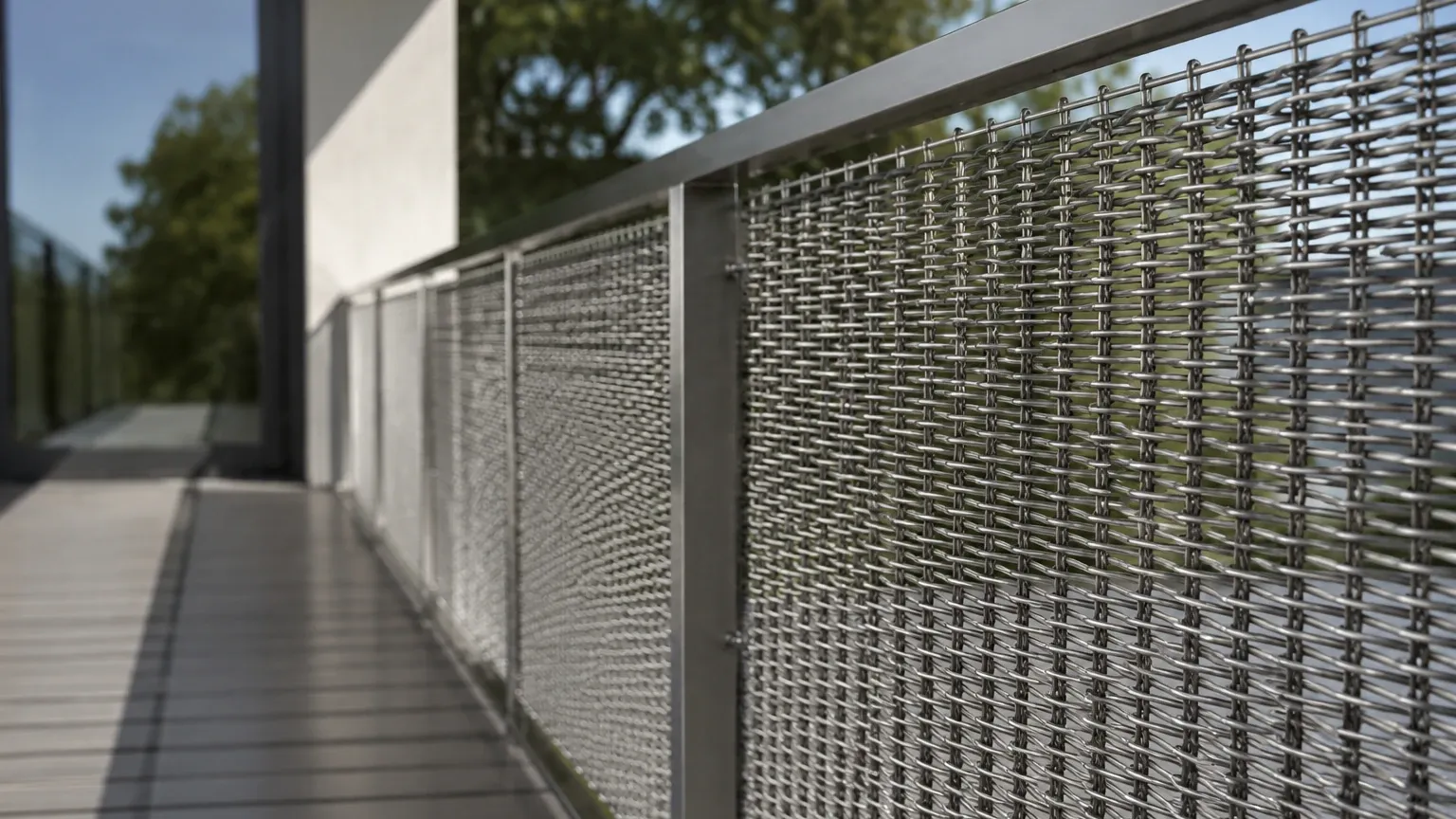
Customization: Framing and Integration
Kaifil provides comprehensive OEM capabilities for woven wire mesh railing components. Customization goes beyond simply choosing a mesh size; it involves the engineering of the entire panel assembly to ensure seamless integration with the site’s support posts.
Edge Treatments
For industrial applications where aesthetics are secondary to function, mesh panels can be supplied with "raw" edges for field-welding into existing structures. However, for most B2B architectural projects, we recommend factory-fabricated framed panels. This ensures that the mesh is perfectly square, properly tensioned, and finished to the required specification (e.g., brushed, satin, or mirror finish).
Finish and Passivation
After fabrication, stainless steel mesh should undergo passivation. This chemical process removes free iron from the surface and enhances the protective chromium oxide layer. For railings installed in harsh environments, electropolishing can further improve corrosion resistance by smoothing the surface at a microscopic level, making it harder for contaminants to adhere to the wire.
Maintenance and Total Cost of Ownership
One of the primary advantages of a stainless steel woven wire mesh railing is its low maintenance requirement compared to glass or painted steel. Glass infills require frequent cleaning to maintain transparency, while painted steel is prone to chipping and subsequent rusting.
Inspection Cycles
In industrial environments, we recommend an annual inspection of the mesh-to-frame attachment points. In coastal or high-pollution areas, a simple rinse with fresh water every six months is usually sufficient to prevent the buildup of corrosive salts. Because the mesh is a mechanical weave, there are no coatings to fail or peel, ensuring that the structural integrity remains constant over decades of service.
Cost-Effectiveness
While the initial material cost of a stainless steel woven wire mesh railing may be higher than wood or carbon steel, the total cost of ownership (TCO) is significantly lower. The durability of Woven Wire Mesh means fewer replacements, no repainting costs, and minimal labor for cleaning, making it the most economical choice for long-term infrastructure projects.
Conclusion: Confirming Specifications for Your Project
When transitioning from design to procurement, engineering teams should confirm the following data points to ensure the woven wire mesh railing meets project requirements:
* Material Grade: Is SS304 sufficient, or is SS316L required for corrosion resistance?
* Wire Diameter: Does the wire gauge provide the necessary structural stiffness?
* Mesh Aperture: Does the opening size comply with local safety codes (e.g., the 4-inch sphere rule)?
* Framing Method: How will the mesh be integrated into the post system to ensure safety and aesthetics?
* Finishing Requirements: Is passivation or electropolishing necessary for the environment?
By addressing these technical variables during the specification phase, engineers can ensure that their railing systems provide reliable, long-lasting performance in any industrial or architectural application.
