


Woven Wire Mesh Roll
In industrial filtration and separation processes, the selection of media is a critical engineering decision that impacts system efficiency, maintenance frequency, and product purity. A woven wire mesh roll serves as the foundational material for a vast array of filtration components, from simple strainers to complex multi-layered pleated filter cartridges. Understanding the technical nuances of mesh construction, material properties, and weave patterns is essential for engineers and procurement professionals tasked with optimizing industrial performance.
This guide provides a technical overview of Woven Wire Mesh, focusing on the specifications, selection criteria, and engineering considerations necessary for industrial applications.
1. Understanding Woven Wire Mesh Roll Specifications
A woven wire mesh roll is defined by several key parameters that dictate its mechanical strength and filtration capability. When specifying mesh for industrial use, engineers must look beyond basic dimensions to the precise geometry of the weave.
Mesh Count vs. Micron Rating
Mesh count refers to the number of openings per linear inch. While this is a standard industry measurement, it does not directly define the filtration fineness unless the wire diameter is also specified. For precision filtration, the "micron rating" (representing the size of the largest particle that can pass through the mesh) is often more relevant. In a standard square weave, the aperture size (w) can be calculated using the formula:
*w = (1 / Mesh Count) – Wire Diameter*
Wire Diameter and Open Area
The wire diameter significantly influences the structural integrity and the "open area" of the mesh. The open area is the percentage of the total surface area through which fluid or gas can pass. A higher open area reduces pressure drop and increases flow rates but may compromise the mechanical strength of the roll. Engineers must balance these factors based on the operating pressure and the viscosity of the medium being filtered.
2. Material Selection for Industrial Environments
The longevity of a woven wire mesh roll depends heavily on its resistance to the operating environment. Stainless steel is the industry standard due to its durability and corrosion resistance.
* SS304: The most common grade, offering excellent cost-effectiveness for general industrial applications where moderate corrosion resistance is required.
* SS316L: Containing molybdenum, this grade provides superior resistance to chlorides and acids, making it the preferred choice for marine environments, chemical processing, and pharmaceutical manufacturing. The "L" denotes low carbon, which improves weldability and prevents sensitization during the fabrication of filter components.
* Specialty Alloys: For extreme environments, alloys such as Monel, Inconel, or Hastelloy may be used to withstand high temperatures or highly aggressive chemical reagents.
3. Weave Types and Performance Characteristics
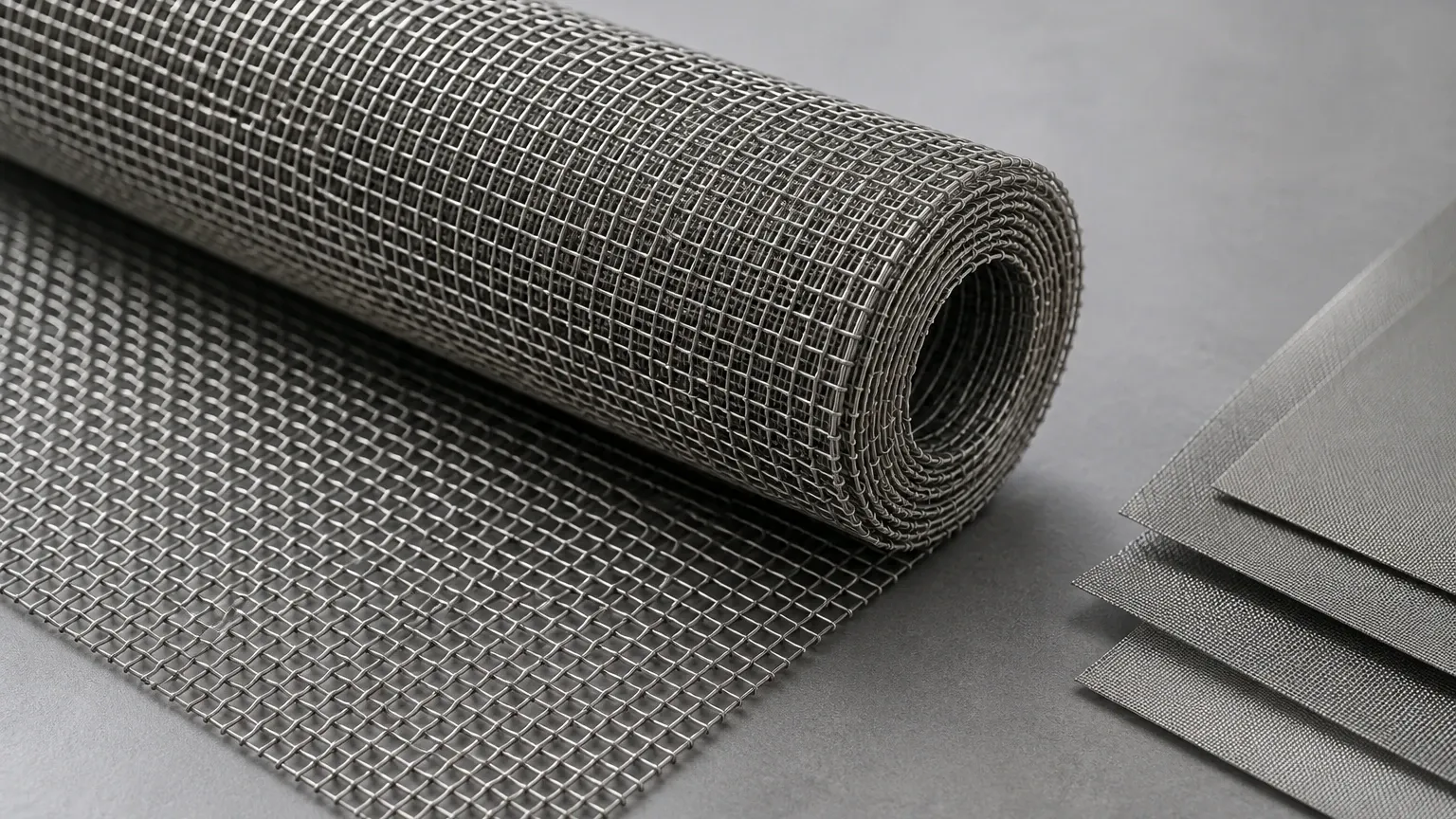
The method by which wires are interlaced determines the mesh’s stability, thickness, and filtration accuracy. Plain, twill and dutch woven wire mesh in SS304/316L — rolls, cut mesh and framed panels. Send mesh count or micron target for a technical quote.
Plain Weave
This is the most straightforward construction, where each warp wire crosses over and under each weft wire. It offers the highest open area and is ideal for high-flow, low-pressure applications. However, it is generally limited to coarser mesh counts.
Twill Weave
In a twill weave, each warp wire passes over and under two weft wires. This allows for the use of heavier wires for a given mesh count, resulting in a stronger and more durable mesh. It is frequently used for fine filtration where a plain weave would be too fragile.
Dutch Weave (Plain and Twill)
Dutch weaves utilize different diameters for warp and weft wires. The wires are driven closely together, creating a dense, wedge-shaped opening rather than a square one. This weave provides exceptional strength and high filtration precision (down to sub-micron levels), making it the standard for high-pressure hydraulic filters and fuel filtration.
4. Engineering Considerations for Selection
When evaluating a woven wire mesh roll for a specific project, several engineering factors must be confirmed to ensure the material is fit for purpose.
Flow Rate and Pressure Drop
Every layer of mesh introduces resistance to the flow. Engineers must calculate the clean pressure drop across the mesh to ensure it does not exceed the system's pump capacity. As the mesh captures contaminants, the pressure drop will increase; therefore, the initial selection must account for a "dirt-holding capacity" that allows for a reasonable service life between cleanings or replacements.
Mechanical Loading and Support
In many applications, the mesh roll is not self-supporting. It may require a perforated metal core or a coarser mesh backing to prevent deformation under high differential pressures. The tensile strength of the mesh should be verified, especially in vibrating screen applications or high-velocity fluid streams.
Chemical and Thermal Compatibility
Beyond the alloy type, the manufacturing process (such as the use of lubricants during weaving) must be compatible with the end-use. For food and beverage or pharmaceutical applications, the mesh must be thoroughly degreased and pass stringent cleanliness standards to prevent contamination of the process stream.
5. Manufacturing Standards and Quality Control
Quality assurance is vital when purchasing a woven wire mesh roll, as minor defects can lead to catastrophic failure in precision systems. Key quality indicators include:
* Aperture Uniformity: Inconsistent openings lead to "bypass," where particles larger than the target micron rating pass through the filter.
* Surface Integrity: The mesh should be free of broken wires, oil stains, or oxidation. For high-end filtration, ultrasonic cleaning is often employed post-weaving.
* Edge Finish: Depending on the application, rolls may be supplied with raw edges or finished (selvedge) edges to prevent fraying during handling and installation.
Industry standards such as ISO 9044 (Industrial wire screens – Technical requirements and testing) and ASTM E2011 provide the framework for evaluating mesh quality and ensuring consistency across batches.
6. Applications of Woven Wire Mesh Rolls
The versatility of the woven wire mesh roll allows it to be utilized across diverse industrial sectors:
* Chemical Processing: Used in catalyst recovery, filtration of aggressive solvents, and as support structures for chemical reactors.
* Food and Beverage: Employed in the filtration of syrups, juices, and oils, where stainless steel’s hygienic properties are paramount.
* Pharmaceuticals: Critical for sterile filtration and the separation of active pharmaceutical ingredients (APIs).
* Water Treatment: Utilized in pre-filtration systems to protect sensitive membranes from large particulates and debris.
* Hydraulics: Fine Dutch weave mesh is essential for protecting precision valves and pumps from wear-inducing contaminants in hydraulic fluids.
7. Maintenance, Cleaning, and Replacement
One of the primary advantages of stainless steel woven wire mesh is its cleanability. Unlike disposable polymer filters, metal mesh can often be regenerated through various methods:
* Backwashing: Reversing the flow to dislodge accumulated particles.
* Ultrasonic Cleaning: Using high-frequency sound waves in a cleaning solution to remove fine particles trapped deep within the weave (especially effective for Dutch weaves).
* Chemical Cleaning: Using compatible solvents or acids to dissolve organic or inorganic scaling.
However, a replacement cycle must be established. Over time, repeated cleaning and mechanical stress can lead to work hardening and eventual wire breakage. Regular inspection for "blinding" (permanent clogging) and physical deformation is necessary to maintain system integrity.
8. Procurement: Confirming the Right Details
To ensure a successful procurement process for a woven wire mesh roll, technical teams should confirm the following details with the manufacturer:
1. Exact Alloy: Specify SS304, SS316L, or other specialty metals.
2. Mesh Dimensions: Confirm the roll width (standard widths are often 1m, 1.2m, or 1.5m) and the total length required.
3. Filtration Requirements: Provide either the mesh count and wire diameter or the target micron rating.
4. Compliance: State if the material needs to meet specific standards like FDA compliance for food contact or specific ISO/ASTM certifications.
5. Post-Processing: Determine if the mesh requires specialized cleaning, annealing, or cutting to specific shapes before delivery.
By focusing on these technical parameters, engineers can ensure that the selected Woven Wire Mesh provides the necessary precision, durability, and cost-effectiveness for their specific industrial application. Whether utilized as a simple protective screen or a high-precision filtration medium, the quality of the mesh roll is a fundamental component of industrial operational success.
